


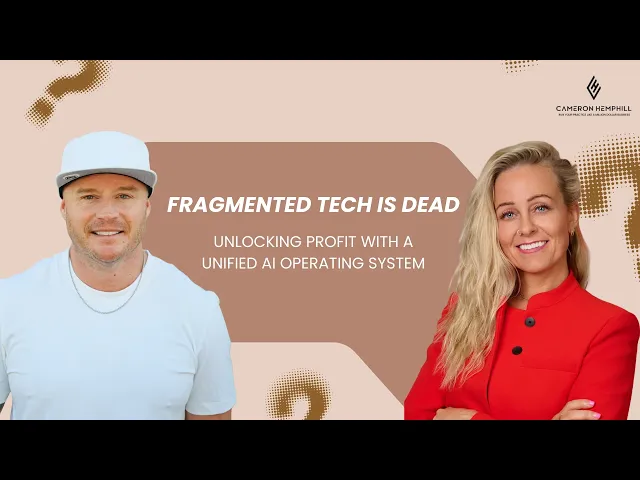
Fragmented Tech is Dead: Unlocking Profit with a Unified AI Operating System
Summary
Cameron Hemphill sits down with Shannon Blake, Director of Aesthetic Partnerships at Podium, to unpack Avery, Podium's AI patient coordinator, and the new AI operating system built around her for med spa and aesthetic practice owners. Shannon traces Podium's path from a fragmented-communication fix to a full operating system that unifies EMR, CRM, phone, and texting, and explains why Podium chose to build its own payments and scheduling rather than wait on integrations from legacy EMRs.
The conversation digs into how Avery taps dozens of AI models to self-heal her own responses, what's live today versus the "revenue mining" features coming this summer, and how consolidating communication into one system is meant to free up practice owners and front-desk teams to focus on patients instead of juggling software. They close with Podium's push into wellness, from e-prescribe to lab integrations, as the next growth frontier for aesthetic practices.
Key takeaways
Avery now references 20 different large language models and makes 50 calls to them behind the scenes to compile a single text response, then self-heals from feedback instead of routing fixes through an engineer.
About 40% of practice leads come in after hours, where the old industry-average response time was 8 hours; Avery is built to respond within two minutes any time of day.
Podium's new AI operating system launched about a month before this conversation and had already signed 150+ practices, migrating roughly 95% of a practice's data within 48 hours for a $99-a-month add-on.
About the Host & Guests

Host
Cameron Hemphill
Founder, Growth99; Host, Medical Millionaire
Cameron Hemphill is the founder of Growth99 and host of the Medical Millionaire Podcast, a business show for med spa owners and medical aesthetics entrepreneurs with more than 200 episodes. He founded Growth99 to bring CRM, automation and performance marketing to the aesthetics industry; the company was acquired by a strategic investor group after nearly a decade of growth.

Guest
Shannon Blake
Director of Aesthetic Partnerships, Podium
Shannon Blake is Director of Aesthetic Partnerships at Podium, where she has spent roughly six and a half years leading the company's expansion into medical aesthetics. She works with med spas on modernizing operations and using AI for patient communication and growth, and she has appeared on American Med Spa Association podcasts and webinars on those topics.
Timestamped Chapter Markers
00:02 – Introduction
01:55 – Meet Shannon Blake, director of aesthetic partnerships
02:40 – Why Podium built an AI operating system
03:52 – Building Avery, Podium's AI employee
07:07 – AI operating system vs EMR
09:04 – Podium's roots in Utah
10:15 – How Avery's AI models keep improving
11:31 – Inside Avery's self-healing AI agents
15:30 – Revenue mining, coming this summer
19:48 – What Avery can do today
24:24 – Dynamic scheduling and EMR comparisons
27:31 – Building in-house payments and scheduling
32:58 – Rapid adoption and 48-hour migrations
39:11 – Tackling wellness integrations
42:19 – Owning the code vs white-labeling
45:26 – How to connect with Shannon and Podium
What is Medical Millionaire all about?
You're listening to Medical Millionaire, your podcast for med spa owners, medical aesthetics, cosmetics, and elective wellness entrepreneurs. Each week we dive deep into powerful marketing strategies, proven scaling tactics, and the secrets to attracting high-quality clients, all while staying ahead of the latest industry trends. Join us as we uncover insights from top industry leaders to help you boost revenue, enhance patient satisfaction, and master the art of marketing your practice. Hosted by Cameron Hemphill, with over a decade of experience in the aesthetics industry, Cameron has supported thousands of practices and providers, working with some of the biggest names, most well-respected brands, and elite industry thought leaders in the field. If you're ready to level up your practice and become a true medical millionaire, this is your podcast. Here's your host, Cameron Hemphill.
Cameron Hemphill: Hey, what's up, everybody? Cam Hemphill, your host of the Medical Millionaire podcast. Thank you so much for taking the time to tune in. My goal is to give incredible value and insight for practice owners. So if you're looking to scale your practice, looking to grow, implement the latest technology, the latest mindset, skill sets, understanding how to run your practice efficiently, effectively, and ultimately potentially get you in a position to sell and create generational wealth — this podcast, we talk about everything. And so today I have an incredible guest on, and I've known this woman for a long period of time. She truly is a trailblazer when it comes to innovation, tech, AI, working with a very powerful company, a powerful brand, a company that I actually know personally, and they've been around for a long period of time. And they're just making tremendous headway in aesthetics, and they're solving a tremendous amount of problems when it comes to running your practice efficiently, running it like a business. They have robust end-to-end solutions when it comes to CRM, when it comes to communication with your patients, AI. And so, without further ado, I'm going to welcome Shannon Blake. She's the director of aesthetic partnerships at Podium. Shannon, how are you? Welcome.
Who is Shannon Blake and what does she do at Podium?
Shannon Blake: I'm doing well, Cam. As a longtime listener of Medical Millionaire, it's always a treat to come on and be a guest, and not just a listener. So thank you so much for having me, and very excited about this topic.
Cameron: Of course. Yeah, you've been on before, we love having you, and when I peel back the curtain at Podium, it just seems like you guys are consistently innovating, consistently raising my eyebrows, like, what are they up to, what are they continuously doing? Huge headwind with AI — you have payments, you have CRM, you have this whole new operating system. This is new stuff. I'm curious to know, for the audience, what is this whole AI operating system that you guys have now brought to the market? Why did you bring it to the market? What problems are you seeing, and what are you guys trying to solve?
Why did Podium build an AI operating system for aesthetic practices?
Shannon: Yeah, happy to answer that, but I think it would be helpful for anyone who isn't as familiar with Podium to take a step back and share with y'all our history in aesthetics. Cam mentioned a couple of years that we brought to the table when we entered this space — about two and a half years ago. So, all things considered, we're a very new tech in the industry, but initially we joined the industry because we knew that we could solve a very important problem of consolidation of communication and consolidation of leads, and that's inclusive of your phone system integrated with your texting platform, your text marketing coming from the same phone number as your one-to-one texting and your phone solution. Pretty quickly once we were in the industry, we realized — yes, bringing all leads into a single platform and all communication into a single platform is valuable, but it was still quite difficult for our clients to be able to get back to every single lead, or every piece of communication that came in, within five minutes, which was the industry expectation, the consumer expectation, at that time.
How did Avery, Podium's AI employee, get her start?
Shannon: So we built Avery, and we've actually been building Avery for a couple of years. She is our AI employee, and her main purpose — we'll talk about her current solution, what she solves for today — but initially was just to get back to every single lead in under two minutes and speak as if she was a member of your team, having her trained on your services, your price points, your treatment plans, your membership packages, everything from A to Z. We knew, especially with some of the folks we're dealing with — staffing shortages — she could not only solve that speed-to-lead issue, but she could also pick up some of the very time-consuming work that comes with responding to questions that are always coming in about different services and treatments. So we launched her out into the market over a year ago. She's our fastest-growing product actually today here at Podium, which has been really fun to see — that was really nice timing with when OpenAI came out with one of the biggest first LLMs and changed the game.
Shannon: So that's been really fun. But to answer your question on this new AI operating system, on why we built it — I think everyone listening to this podcast is going to really relate to this comment, but we've learned through client feedback that technology, specifically, is a couple things. It's fragmented. A lot of folks are using a CRM that's not integrated with their EMR. They've got a different phone system that's not integrated with their texting. Really, a lot of folks are using about four to five different systems — that's what we found. But also, as we listen to our client feedback, nobody loved their EMR, and we started doing a deep dive into why this might be — and this is our findings, and Shannon's theories — but, and this might be an unpopular opinion, EMRs have actually a quite good retention rate with their clients, and that has allowed them to be a little bit more stagnant and not as fast-growing, whereas with Podium, we've always been a luxury add-on product. We weren't the main system that they ran their business through, with their payments and scheduling, their charting and forms.
Shannon: So we are a luxury add-on, which means we can't be still — we have to move fast, we have to be innovative, we have to be scrappy, we have to show value, or it's very simple for folks to just end the relationship with Podium, which obviously we didn't want. So taking this all into consideration — knowing that we've got funding, we've got resources, we love to build modern tech that's intuitive, easy to use, cutting-edge — we felt like, and we couldn't get the integrations that we wanted, I think that's worth noting, so we had to go build the whole thing ourselves. And I feel like we were perfectly set up to do so, because Podium, all things considered, was a really modern tech platform. For some of these EMRs that have been around for a long time, the foundation of their system is just old tech, so it's going to be quite difficult for them to move as quickly and build more modern solutions leveraging AI on top of that. We were positioned to be able to move really quickly, which is what we've done.
What makes this an AI operating system instead of just another EMR?
Shannon: So let me answer the question on the AI operating system, because you might be wondering what exactly that is and how it's different from an EMR. If you think about having your EMR, your CRM, your phone system, your text and email marketing all in one solution, and now with the involvement of AI and having an AI employee — Avery — this AI employee can have access to every piece of information, every conversation, every detail around what clients have purchased, she can do really incredible things. Cam, I do want to talk about one of the most valuable things that she can do now, now that she is managing and has access to all information in this operating system: if she can manage your scheduling end-to-end, period, like, no human should have to go back and forth and manage scheduling appointments. So I would say that's one of her biggest value-adds, being able to own that full scheduling piece. But then, you think about how charting is moving to leveraging AI to listen to that appointment and then fill out the charts in all of the right fields where you want them. There's so much Avery, this one AI employee, can do when she has access to all your systems, which is just Podium now, in this AI operating system. That was a lot, so I'll pause there.
Cameron: Well, it's a huge announcement, it's a huge update. I mean, I've known Podium for many, many years — shoot, I think the company was founded 2010, something like that?
What's Podium's footprint out of Utah?
Shannon: Okay, so four years off.
Cameron: I'm originally from Salt Lake City, Utah — you guys are headquartered out of Lehi, Utah, Silicon Slopes. Just to build on that for a second, there are so many powerful, inspirational entrepreneurs and influencers — Utah has something at heart, and there's a ton of innovation that comes out of the state, and Podium is sitting right in the center of all of it. You guys, headcount at Podium — what is the headcount there?
Shannon: We have just over a thousand employees.
Cameron: A thousand employees. I've been to your HQ, it's phenomenal — you guys have beautiful buildings, you've done such a great job. I could talk about that because I was a local before I decided to uproot my family and head down to the beach. But I just want to let the audience know, you guys have been around a long time, and originally it started out as a review platform, a feedback loop, right? Still one of your core features in products, and it's really served the medical aesthetics industry very well in terms of helping patients give feedback when it comes to the practice, with ease, through text, email — all of it, the feedback loops that you have.
How does Avery get smarter with AI models?
Cameron: Then you guys go on, you launch a CRM system, which has triggers, automations, it has AI, and you mentioned one thing — when you're talking about the AI, I want you to talk more about the LLMs, right, the large language models, because I think most people are curious, but from a provider standpoint, how does Avery get smarter? How are these LLMs becoming more powerful? How are they continuing to learn, because that's important, right, as they continue to use the product and adapt to the product, as the patient is interacting, Avery's interacting back — they have to become smarter, there's so much time saved. Talk to us a little bit about that first.
Shannon: Yeah, so for those of you that are the AI geeks out there and know all the LLMs — Podium actually initially built Avery off of OpenAI, like I mentioned, but pretty quickly we realized there are a lot of really good competitors who are good in different ways. You know, Gemini for Google, for example — there's all these different ones that have their different strengths. Today, Podium has actually evolved, and Avery now references twenty different of the top LLMs for various types of tasks that she's doing, and what's really interesting — this is maybe getting too detailed into the weeds, but I think it's helpful to understand so you get her true value — every single text that comes in for one of our aesthetic practice clients, Avery is making fifty calls to different LLMs to compile and spit out the response to that single text, to make sure that it is the absolute best response, while also tapping into all of that specific practice's training that was given to her, that is specific and tailored to that practice.
How does Avery's self-healing AI actually work?
Shannon: So how she is self-learning — originally Avery didn't self-heal. She would reply, and if the practice didn't like the reply from Avery, they would do a thumbs down and type in some feedback on how they would have liked her response tweaked. That went to a Podium engineer, and y'all can imagine, as we grew to over a thousand locations using Avery as an employee, that was not scalable for a human to go in and research, determine, and make tweaks. So Avery v2 was launched about six months ago, and she's completely self-healing. We actually had to build mini AI agents behind Avery, so that when feedback was provided, it would go to these agents, and they would run through a bunch of different data on the back end, reference all of these LLMs, and then spit out a new response to make sure that the practice would be comfortable with that — this is what she would say in the future — and it's automatically self-healing. You don't need anyone to go in and make any changes. In the future, Avery is not going to make that same mistake twice. It's really nice, because all of you, I'm sure, have played around with ChatGPT and understand the general idea of giving feedback — if you have it write an email for you, you can write feedback around, hey, I want you to sound a little less professional, or make it more concise. That's how you give Avery feedback. It doesn't need to be pretty or well thought out, you just dump your thoughts in there, and then she will self-heal moving forward.
Cameron: It's interesting when you bring up ChatGPT — I don't want to get too sidetracked, but I use it extensively, I use a tremendous amount of AI products. Some of my favorites — obviously the GPT models, Claude is something I've become a huge fan of, and also Gamma, for different reasons. And what I found with even my ChatGPT LLM is it's learning more and more about me, it's becoming this extension of me — it's kind of creepy, but it's efficient. It knows where I live, it knows my style, it knows what hobbies I like because I've talked about a lot, I have all these different models and projects in there, and I can ask it various questions, like investment advice, for example, and it will reply back and say, well, Cameron, you're a very sophisticated investor and you've done all these things, and it has all the history. So, to build on what you're saying, I love the fact that she's self-healing, because I can understand the initial frustration of getting those inadequate responses, right, and I think that's always the fear — it's like, hey, we want to use AI agents broadly, let's say from a macro standpoint, sounds great, give me a hundred of them, you know, do everything for me, right? But also, what if they make a mistake, and that mistake can be costly for a practice? Let's say, for example, a patient is inquiring, they're going back and forth, and maybe it's not the tone or the dynamic of the practice, or they recommend a wrong treatment or wrong service. And you guys have done a wonderful job of building your AI agents to self-heal — love the fact that you've released that, and I think it's a true testament to who you are as a company, and also giving that intrinsic value to practice owners and ultimately the patient experience, because that's what it's all about.
What is revenue mining, and when is it coming?
Shannon: Yeah, and Cam, I want to say something to that point of her always learning more about you — Avery is learning about your clients. I'm speaking to a practice — she is learning buying behavior, she is learning how often they're coming in, she understands what their insecurities are, because Podium now is the EMR, the CRM, the marketing, everything — she has all the information. She has the phone conversations, she has the text, she has which promotions you're running that people are taking advantage of. She knows more than you will ever be able to know, and in a more efficient way. So what gets really exciting is what's coming in the summer for Avery — what we're calling revenue mining. That will allow Avery to start following up with folks who bought a retail product that she knows is going to run out in thirty days — proactively reaching out to Amber and letting her know that the pill treatment she purchased a month ago should be running low, we've got it stocked here in the practice, would love to have you pop in and get that replenished. She will know if somebody came in for Botox and it's been over four months and, for whatever reason, they're not rebooked. She will proactively follow up with them and get them back on the calendar, without any human having to do anything. It gets really exciting if you start thinking about an AI employee that has access to all this information, what she can do proactively, without any more resources, because we're all running a little thin in this industry — a lot is being asked of you, and there's so much that's going to be able to take off your plate, but also drive you revenue and make you more profitable.
Cameron: Wow, you guys are solving some big, big shit, I'm just going to say it that way, because look, in today's environment, from a practice standpoint — look, I own some practices through private equity, I've consulted on some practices, I've been pretty hands-on in some and distant from others. But, me owning Growth99 for many years, I've had thousands and thousands of conversations with practice owners and the challenges. So let's take it from a lead standpoint — an inquiry comes in, that could be a text, an email, a lead form, or an ad that comes into, historically, an inbox, and then finally gets into the CRM, and now finally has an AI agent that can follow up with it. But what you're saying is Podium has now taken it to the next level, because you saw this deep challenge, you saw the same lens of frustration — hey, this is fragmented, you have to have four or five pieces of tech, API them together or copy and paste data, while the practice is running at full RPM — typically the provider-owner is visiting patients, and how can a provider-owner run an effective business, seeing patients all day, with fragmented technology? It's impossible. And what happens is burnout is real — I've seen practice owners have to take their entire workload, charting, social media content, after hours, right, because they see fifteen patients a day and they don't have the resources to even work on the business. So you guys are solving real needs here, and I just want to make sure I hear it correctly — it's more than an EMR, I love the term operating system, because it can take inquiry to booking, to ongoing booking, right, and that's a big challenge too. I don't know too much tech in the industry that can flag a patient who hasn't come in for a certain period of time — hey, you're actually due for this particular treatment. Let's say GLP-1s, right, you have to re-up every thirty days as the product runs out, you have to have the conversations. So I guess you could build something that has automated triggers post-treatment, but what you're saying is this is now a self-initiated agent inside the ecosystem that's going to flag — Sally, she came in two months ago or a month ago, I'm going to reach out to her and communicate with her and get her back on your books — and that's live today?
What can Avery already do today?
Shannon: That is revenue mining, and that is coming out in the summer. So, to be clear, that is not live today. What's live today is Avery — what she can do is obviously everything I said: respond to every single lead in two minutes, answer any question, fully book appointments, recommending dates and times, working through all of that. She knows how many devices you have, how many providers, can manage which laser device, for example — she can manage all of that, and she can definitely follow up with any leads that go cold today. So if the lead comes in, she has a great conversation, the lead for whatever reason doesn't book, the lead goes quiet — Avery knows to follow up, you give her guidance on whether you want her to wait twenty-four or forty-eight hours, you can customize that, and she'll follow up with those cold leads. What's coming is reaching out down the road around inventory replenishment, treatment plans that aren't being taken advantage of, memberships — we haven't even talked about that, Cam, memberships are so underutilized, and depending on your membership structure — let's say it's a piggy bank type model — we want them using that money, otherwise it's just sitting as liability, right, for treatments they haven't followed through on yet. So her being able to follow up and say, here's what outstanding funds I have, let's get you on the books, what treatments are you most interested in right now, answering those questions and getting them scheduled — that's all live today. The revenue mining and profitability piece is coming this summer, and I say this summer, but honestly, Cam, I was just looking at the product updates that came out last week, and there were seven new big things that we rolled out — we're moving very quickly, so it would not surprise me if this comes as early as April, which we're pushing for — we would love to do a big unveiling at the Medical Spa Show in Vegas.
Cameron: Coming up here, what, April ninth, tenth, eleventh, something like that?
Shannon: Yeah, ninth through the twelfth. And to your point about mentioning an EMR, we wanted to be really mindful of what we call this system, because an EMR implies a data storage spot for my charts, my forms, my schedule. It is not a profitability-driving machine. It stores information, and that information is literally gold if you can pair it with an AI employee who is smart and can proactively create more bookings from that information. So we wanted to make sure that we had something very strategic, so it didn't just sound like another EMR, because those three letters don't necessarily have a very positive perception in this industry. It's a must-have, and I haven't — some people look, there's features missing or not missing, there's a love-hate for every single one of them, from what I've found, and some people are doing things much better than others.
Can Avery handle dynamic scheduling, and how does it compare to other EMRs?
Cameron: To your point, it sounds to me that you're able to take a lead, automatically follow up with that, and then convert it into a booking. So it does have the ability to actually read all the providers' schedules — it can see when they're open, has dynamic scheduling? Can it see availability and look at all the KPIs and metrics around utilization rate, all that stuff?
Shannon: All of that stuff, yeah — even down to suggested times, to make sure Avery's being smart about when she's scheduling that person, bumping it up as close as she can to another appointment, so there's not that wasted time in between. It's interesting, as we've done a lot of research on what other EMRs are good, where it's wild how much work has gone into EMR comparison — there are all these articles out there, and I follow a lot of Facebook groups, and providers and owners will share things like, I tried this one but it didn't have anything to help me with wellness, it didn't have e-prescribe in it, or it didn't have integrations with labs, or the charts are really hard to use, or the forms are glitching, not customized — and it's like, why can't somebody just go out and build the dream solution? And again, we just felt like we were positioned — we have the funding, we have the manpower, and we have the guts to go out and dream big and build fast, and they're no longer the days where you have to compare side by side like that. It shouldn't be that way, and we really believe that we will level up all tech in this industry, because it's just a different game now, ever since AI came out, really publicly, so it's going to get really exciting. I'm just excited holistically for this industry because it's so competitive, and there's a lot of folks struggling right now, because I think it probably grew faster than it should have, and having good tech that can proactively drive revenue for you is going to be critical to survive.
Why did Podium build its own payments and scheduling instead of integrating?
Cameron: Yeah, absolutely. I mean, the fact that you guys took on that initiative — what you could have done is just focus on making lead conversion smarter inside the ecosystem, obviously building on the features you already have, but you took a stance, and I have a lot of respect for that, because I knew somebody was going to do it, I just wasn't quite sure who, I couldn't peg it. It's something I'm obviously very passionate about. I was consistently frustrated — generating leads for practices through Growth99, having those leads go into our native CRM and then being able to push those into an EMR system, and I would knock on the EMR's doors for so many years, and I would always just get pushback, and I said, my challenge to them was, hey, look, we're the ones actually driving the revenue, we drive the booking, the marketing agencies drive the booking, right, the practice doesn't own that, and so there's a lot of value there, and I think that they're being undervalued by the EMRs. And I think, as you guys entered the market as well, you came in — the phones and texting were huge, right, solving that problem was huge, most practice owners were using, you know, and sure, I guess it worked, they'd pass the iPhone on to the next provider or front desk person whenever their shift came on — and solving that communication gap was absolutely critical. And then you obviously bolted on the AI component, but why did it get to the point where — and I know you're ambiguous, goal-oriented, again, we talked about that — how is this decision made? I'm curious, like, why, go deep.
Shannon: Yeah, yeah, yeah, I mean, here's the thing, Avery was good, but she was very limited, and we didn't love that we didn't have payment processing data, and we didn't have scheduling — which, guess what that means, we can't show good reporting. Reporting is king, people want data insights, it is so valuable, and we knew, if we could be the payment processor — which we already had a payment processing product that we use in other industries we're in — but we couldn't use it because the EMR blocked it, and Avery also not being able to actually schedule the appointment, but just send a link to schedule, that really limited Avery, and she is our differentiator, she is special, we win awards for her, I'm not exaggerating, she is the best on the market. She is not perfect — no AI is perfect right now — but she is the best on the market, and we are constantly improving her. So that was like giving Avery a superpower — that is why we built it, and we could not get the integrations we needed, Cam. I know there are EMRs out there that wouldn't take the call or the email, they just didn't prioritize it, their retention numbers were decent, I don't want to say they were lazy in building, but there just wasn't a big motivator — maybe they looked at us as an up-and-coming competitor. But we initially were not planning on building this — when we couldn't get the integrations with the scheduling or the payments to get the data to help Avery become more valuable, we had to make the hard decision. We did — it took us seven months to build something pretty incredible, really proud of that. And now that we've built the fundamentals, the features we're adding weekly is like literally ten features, where we'll see some of these other EMRs launch something in a quarter, and it's like, we built that in a day. So we're just ready to dominate this industry and give these practices the tech that they deserve and need at this specific time in the aesthetics industry, and that's also keeping in mind that wellness is making a run — wellness is the future of aesthetics — so we knew that had to be on our mind, to make sure we were building all those features that folks were having to use other tech, integrated with their EMR, to manage the wellness side of things. So that's also top of mind for us.
How effective has Avery been at capturing after-hours leads?
Cameron: Yeah, that's huge, I want to get into wellness for sure, because I agree, it's where everybody's going — it's an area focused on peptides, GLP-1s, people healing from the inside out, it's so top of mind, everywhere you go there are a lot of conversations around safety, compliance, how do you integrate the tech. Some EMRs are very limited on how they handle wellness, they don't have the scripting component, right, they don't have the ability to pull all that data back into the EMR system, or AI operating system, is what I'll call it. But it's a huge topic, and somebody has to solve it, right. And so when I look at Podium, the way that you guys penetrated the market, you did a phenomenal job, tons of respect for you — you came in, you're a true entrepreneur, honestly, Shannon, I've seen you cultivate relationships, I've seen you guys help so many practices, and I follow a lot of the providers that use your product. There's one in particular that always stands out — she was showing the other day, I happened to be on Instagram, and she was showing, look, this lead came in, I didn't touch it, it was on Saturday, the AI agent reached out, and then they booked an appointment, and she's just showing it like, that's pretty slick.
Shannon: It is — it solves one of the biggest problems, which was those after-hour leads. You all know the average response time was eight hours — like, nobody wants their employees working after hours. So, her being able to take that lead after hours and turn it into an appointment while you're asleep or spending time with your family is really valuable in itself.
Cameron: Well, it's interesting too, that most of the leads I've seen, the high-quality, high-converting leads, they do come in after hours, because this is when people are outside of work, they're going to go do the Google search on their phone, or scroll on Instagram, outside of work, and actually have the time to make an inquiry, not just look at it and hope they see it later.
Shannon: Exactly, you nailed it — it's funny, that's the personal time we get as humans, is in the evening, and that is the time you're closed. So it's a major problem — I think 40% of leads are coming into your website after hours, so it's a significant problem, and we were happy to solve it.
How fast is Podium growing, and how smooth is onboarding?
Cameron: So where do you go from here? You guys have launched this, I know you have an ecosystem of current base clients — do they automatically inherit it? How do they learn about it, do they have to bolt it on?
Shannon: Yeah, it's a good question. So we launched this just over a month ago. We have a full sales team that is proactively outreaching, literally cold calling, Cam — a really good, hungry sales team that just picks up the phone, they have no shame, and they get them set for a demo, and we've already brought on about a hundred — I think we're over 150 now — practices in just under a month, which we weren't quite sure how fast we'd be able to grow, because switching your EMR, we didn't think — we heard it's expensive, it's time-consuming, and so we weren't quite sure if we were going to be able to continue the model of, we were one-call-closing the old Podium, the original Podium. So we wondered what it would do to our sell cycle, but we found that our sell cycle is actually shorter now, because we've made the migration process a lot easier with AI — a lot of that can be done in under 48 hours, it doesn't need to be this drawn-out, months-long process anymore. So we've been very pleased at how open and willing folks are to even keep paying their old EMR fee and bring on a new platform, because they're like, this is going to make me money, I'll pay both until I'm out of contract with the other one, if you guys can solve for the migration piece.
Shannon: So we are picking up the phone and calling on net-new, and then, as far as current customers, we have a full customer success manager team that is doing account reviews with our clients, and at every account review they are bringing up and showing them our new operating system, and for them to add it on is $99 a month. So it's really not a big additional expense, considering it replaces their EMR, and in some cases allows them to cancel a few different tech software monthly fees — so it's a net positive at the end of the day.
Cameron: Okay, let me talk about that for a sec, because I know you said that retention from legacy, current EMRs — their base typically is loyal, because it's a pain to switch, right — there are patient records, future appointments, recurring memberships, credit cards that have to be canceled and spun back up. It's a pain, and I think practice owners get locked into this ecosystem, because when can they change? They just kind of put up with what they have, and hopefully that particular platform releases updates and features and gets better, right? They're always releasing new updates and features. But what you're saying is your onboarding experience — you've somehow simplified that with AI. That's a big thing, so I want you to talk about that a little bit more.
Shannon: Yeah, it's huge. It's funny, our CEO, he's a bulldog, man, he has very high expectations — when he learned that the migration process for EMRs is a month at the fastest, and sometimes it takes three months to move things over, he immediately challenged the team that he wants that in 48 hours or less, and fast, because it's going to be quite difficult to get people to switch over if we're saying they're going to have to go through this for one to two months again. So we're really proud of how much of it we can get over within the first 48 hours. I actually joined one of the first onboarding calls last week, and before even that first one-hour meeting, when we start connecting the Google accounts — because we're helping you collect Google reviews — and connecting your Facebook accounts, so those ad leads and Facebook DMs, for example, are coming into Podium — on that call, all of the services, schedules, current scheduled appointments, probably 95% of all that data had already been migrated over, before that first call with the practitioner, because we get the credentials to log in and start extracting all of that. So it was really cool to see their response to how much we had already pulled over, and the only thing we hadn't pulled over yet were photos and charts, which they were still working on. And you do have a dedicated onboarding manager for the first 60 days, who is doing as much of the work for you as they can. There are some things where we will tap you in to help out, but we do as much of it as possible — like I said, 90 to 95% of it we can pull over without you even being on the call, nobody from your team has to invest time, we just need login information, and we're able to move it over. And best believe, the challenge is still on the table, how do we get those photos and charts over just as fast, and we will, I have no doubt, solve that very soon. But it's a much easier migration process, and we don't charge any extra for it.
Cameron: Nice, okay — seamless transition, easy migration, I think that's the biggest challenge. Look, the features, the benefits, the value all make sense to me — I've been in this fragmented industry for so long, and it's nice to have a cutting-edge company like yourself that's innovating in the space and truly solving this desperate need for practice owners, and really giving them their time back. That's the ultimate goal here — time to focus on in-person relationships, nailing the strategy of the consult, for example. Those are things that AI can't replace — AI cannot manage those in-person relationships and build that trust and credibility, and be smart about the treatment plan you put them on, that's meeting their needs and giving them the outcome they need.
How does this give practice owners and front-desk teams their time back?
Cameron: That's where we want to give time back to practices, to really nail that, and also for front desk to be able to go back to being a hundred percent engaged during the check-in and checkout process, to really educate and talk about membership benefits and signing up new members, and maybe an event coming up that you want to invite them to — that check-in and checkout time should be uninterrupted, and that is what our AI operating system, Avery, can do for the practice.
How is Podium tackling wellness integrations?
Cameron: So, shifting gears for a second, I want to talk more about wellness. I know we touched on it a second ago, but I know — what are you guys doing in terms of solving on the wellness aspect? I've seen practices use multiple EMRs — they have to — and then they have two databases of patient records, one is sending texts, the other one is sending texts, they have three different phone numbers, one is connecting with the compound pharmacies, the other one isn't. So then when a practice owner says, hey, look, I've been in injectables and aesthetics and doing laser treatments, microneedling, facials for years, I want to be on this wellness run, but their current infrastructure and systems can't handle it, so they go buy another EMR, which causes more fragmentation. So talk to us — what are you guys doing there, how are you forward-thinking there?
Shannon: Yeah, I mean, the other EMRs in the market are thinking about wellness too — what's challenging is maybe they have less funding, less resources to build it, maybe it doesn't make sense for them to build a wellness suite on top of their older, antiquated tech. What we're starting with is exactly where clients want us to start, right out of the gate — they said, you've got to have an integration with something like DoseSpot, or some e-prescribe platform, so we now have e-prescribe right inside Podium. We're in conversations with Bridgeline and talking about a one-stop shop, being able to order all the pharmaceuticals they need for that. Lab integrations are coming out in April, so having those integrations in there — think about it, if all your wellness is inside this AI operating system, and Avery can now manage, let's take weight loss, for example, or hormones. I go to a local aesthetic practice for my hormones, and I find myself managing the follow-up, to make sure I'm going in every four months to get my pellet, and even when I get my blood work, I'll be honest, I don't hear from the practice about my results, I have to call in and ask, did you get my results, what are my levels at — and it's not because they don't care, but there's so much going on, it's hard to remember to follow up with everyone. If you have all of this wellness data inside this operating system, and an AI employee who can communicate results, or remind you that you're due for your pellet, let's get you on the schedule — that's the power. It works very similarly to the rest of aesthetics, it's just having e-prescribe, lab integrations, and the AI employee to help manage these weight loss programs, and the follow-up on the different programs you're on. It's going to change everything, truly, and again, going back to it all being in one place versus various systems — because there are EMRs out there that have put a bit of focus on wellness, but maybe their CRM is just a white label slapped on from something like GoHighLevel, for example. That's another thing I have to highlight — we built everything in-house, there's no white-labeling of products, which I think allows your tools to be more intuitive and work more seamlessly together, versus two different platforms that appear to be one.
Why does owning the code instead of white-labeling matter?
Cameron: Yeah, you control the code, you control the code base, you can listen to your users. I agree — I think GoHighLevel's done a pretty decent job building out their CRM, they have a lot of bells and whistles, but you have to own your own code, and I'm a big believer that otherwise you're at the mercy of what they're developing. I mean, I know they have some open stuff you can build on top of, but that's huge. I think, too, people didn't really understand, when you were reaching out to do these integrations, how large of a company Podium actually is — they're like, oh, they're the new kids on the block, who knows if they'll be around — and me being from Utah, I'm like, I don't know, they're pretty big, I've been around, I don't know what your revenue is, but I know it's up there.
Shannon: It is, yeah — unfortunate for them. We do have a lot of money behind us, and again, I think it just goes back to how fast you can build — how modern your tech is allows you to build faster, and we've just been well positioned to do so. So we're excited, we're over the moon about it, it was the right move, and hey, I wish the rest of them the best of luck, I truly hope we help level up tech around the entire industry, because they deserve it. And although things have slowed up in aesthetics, wellness is going to have revenue up and to the right again, for the folks that are smart, bring it into the practice in a thoughtful way, and also have the technology to enable them to scale it.
Cameron: Yeah, you have to have the tech, you have the marketing, and you have to have the fulfillment and the customer service, right, and right now that is definitely missing — everybody wants to be a part of it, they're just not sure how to be a part of it. Today, I take GLP-1s, I microdose them, and I take peptides, I can do them from my house, right, I don't have to go to a practice — I did in the very beginning, and now I know my protocols and my stack and all that stuff, so I can do it right from the house, which is huge. So the fact that there's also the fulfillment, the delivery aspect of it — having the system communicate with the portal, communicate with a pharmacy, so the patient can actually receive the drugs at their house on ice, and then have instructions and protocols on how to distribute this into their body safely, is also huge.
Shannon: Yep, and that's even like, how do you want to speak to your clients about the safety of it, and the direction of it — having your AI employee know exactly the protocols, the safety, the way in which you want to speak to your clients about it, that's all trained.
Cameron: It just makes your life so much easier, truly, I love it. Well, I will see you probably at the AmSpa conference, I'll be at 4S as well, in Tucson — I don't know if you'll be there.
Shannon: We will be there.
Cameron: Okay, yeah, that's coming up too.
Shannon: Yep.
Cameron: Perfect, okay. So, look, I love having you on, thank you so much for doing everything you're doing in the industry. Thank you for joining.
How can practices connect with Shannon and Podium?
Cameron: If people want to connect, where's the best place for them to go to learn more?
Shannon: Yeah, so — in fact, I should already have this memorized, let me tell you our website — but I'm a little crazy, and I'll also give out my cell phone number, I love to hear from practices in the industry, so I'll give that first, then I'll give the website address. My cell phone is [phone number removed]. It's Shannon Blake, text me, I'm a text girl, or feel free to give me a call, happy to answer more questions. And then if you want to learn more about it on our website, it's aestheticspodium.com.
Cameron: Perfect. Shannon, thank you so much for joining — there you guys have it, cutting-edge firm Podium, out of Salt Lake City, Utah, Lehi, Utah, Silicon Slopes, doing big stuff in aesthetics. I'll see you soon, appreciate it, thanks. Till next time, happy injecting.
Thanks for tuning in to Medical Millionaire. Every week we're here to help you transform your practice into a thriving, profitable venture, covering everything from marketing and patient bookings to mindset, workflow automation, and beyond, whether you're just starting out, scaling up, optimizing operations, or planning your exit strategy. This podcast is your go-to resource for success in the medical aesthetics industry. It's time to supercharge your practice and take action today. Make sure to tune in to the next episode of Medical Millionaire.
" width="1419.771402332918px"><path d="M 1101.4 94.795 L 1162.11 94.795 C 1162.71 101.29 1163.22 106.749 1164.01 115.715 C 1182.09 95.791 1202.1 86.825 1226.82 90.093 C 1238.318 91.245 1249.327 95.333 1258.79 101.965 C 1268.279 108.622 1275.91 117.593 1280.96 128.027 C 1311.46 88.937 1342.86 79.295 1378.61 97.146 C 1390.371 102.775 1400.331 111.571 1407.37 122.546 C 1414.428 133.558 1418.301 146.309 1418.56 159.386 C 1420.85 206.206 1419.19 253.184 1419.19 301.119 L 1358.56 301.119 L 1358.56 258.364 C 1358.56 233.779 1359.07 209.194 1358.01 184.649 C 1356.86 158.948 1347.17 146.994 1329.41 146.316 C 1310.94 145.599 1296.43 157.673 1293.82 181.66 C 1290.85 210.589 1291.68 239.916 1291.01 269.083 C 1290.77 279.005 1291.01 289.006 1291.01 300.442 L 1229.39 300.442 C 1229.39 268.924 1229.63 237.326 1229.39 205.767 C 1229.39 194.531 1230.38 182.258 1226.34 172.336 C 1222.31 162.414 1213.13 148.867 1205.18 148.11 C 1194.47 147.114 1179.83 154.206 1172.32 162.733 C 1165.44 170.702 1163.81 184.728 1163.42 196.204 C 1162.35 230.591 1163.06 265.019 1163.06 300.721 L 1101.4 300.721 Z M 987.455 300.441 C 986.941 293.906 986.467 287.49 985.755 278.365 C 962.025 309.446 931.768 312.912 900.207 300.281 C 867.578 287.251 855.674 258.323 854.803 225.171 C 853.696 182.256 854.527 139.262 854.527 95.072 L 916.265 95.072 C 916.265 118.582 916.067 141.613 916.265 164.604 C 916.265 182.495 916.66 200.466 917.728 218.277 C 918.756 235.371 926.825 247.565 944.939 249.278 C 963.053 250.991 976.184 242.624 981.365 225.37 C 984.657 213.266 986.32 200.777 986.309 188.233 C 986.981 157.83 986.506 127.387 986.506 95.391 L 1047.61 95.391 L 1047.61 300.361 Z M 803.391 300.881 L 744.065 300.881 L 744.065 95.633 L 803.391 95.633 Z M 803.233 54.906 L 743.907 54.906 L 743.907 0.316 L 803.233 0.316 Z M 629.09 0 L 629.09 110.095 C 572.928 79.932 532.31 84.515 500.235 123.524 C 466.459 164.605 465.905 229.913 499.286 270.955 C 506.714 280.676 516.028 288.798 526.669 294.834 C 537.285 300.855 549.013 304.661 561.142 306.02 C 587.523 309.009 609.196 299.087 628.18 278.805 C 629.129 288.567 629.723 294.744 630.276 300.521 L 690.235 300.521 L 690.235 0 Z M 584.279 249.836 C 556.594 249.836 537.649 228.36 537.847 197.479 C 538.045 166.598 557.108 145.957 585.308 146.395 C 611.846 146.754 631.384 168.351 631.7 197.638 C 632.017 226.925 611.727 249.677 584.279 249.638 Z M 148.037 12.276 C 99.351 4.746 49.161 6.698 0 4.506 L 0 301.362 L 63.597 301.362 L 63.597 209.954 C 88.909 208.798 111.453 209.516 133.443 206.408 C 156.213 203.686 177.279 192.891 192.872 175.954 C 208.466 159.017 217.57 137.044 218.556 113.964 C 221.087 66.029 192.808 19.17 148.037 12.276 Z M 153.021 109.541 C 152.565 119.233 148.448 128.392 141.501 135.166 C 134.584 141.909 125.344 145.744 115.685 145.881 C 99.351 146.638 82.977 145.881 65.1 145.881 L 65.1 69.775 C 84.045 69.775 103.108 67.942 121.657 70.293 C 126.279 70.785 130.757 72.192 134.829 74.433 C 138.911 76.679 142.507 79.711 145.41 83.355 C 148.321 87.009 150.483 91.2 151.773 95.69 C 153.066 100.186 153.463 104.892 152.941 109.541 Z M 338.829 89.811 C 324.732 89.896 310.792 92.776 297.816 98.284 C 284.814 103.804 273.03 111.838 263.142 121.925 C 253.226 132.039 245.394 144.002 240.088 157.134 C 234.77 170.291 232.078 184.361 232.162 198.552 C 232.244 212.742 235.101 226.78 240.572 239.873 C 246.031 252.942 254.003 264.811 264.037 274.806 C 274.043 284.774 285.92 292.667 298.985 298.033 C 312.026 303.387 325.998 306.101 340.095 306.018 C 400.963 305.779 448.226 258.72 448.424 198.154 C 448.542 136.671 400.805 89.453 338.829 89.811 Z M 340.688 247.842 C 315.257 248.28 294.256 226.524 293.584 199.03 C 292.911 171.536 314.545 147.23 340.174 147.23 C 365.13 147.23 385.618 169.624 385.894 197.477 C 386.171 225.329 366.515 247.364 340.609 247.842 Z M 1383.544 85.148 C 1378.393 85.148 1374.345 83.822 1371.39 81.17 C 1368.445 78.519 1366.968 74.996 1366.968 70.602 C 1366.968 66.436 1367.913 63.178 1369.804 60.83 C 1371.695 58.481 1373.931 57.308 1376.502 57.308 C 1378.777 57.308 1380.52 58.14 1381.732 59.807 L 1398.642 39.921 C 1398.8 38.179 1399.214 35.338 1399.893 31.398 L 1410.678 25.717 L 1412.5 26.967 C 1410.983 29.77 1409.998 32.687 1409.545 35.717 C 1409.092 38.672 1408.866 43.406 1408.866 49.921 L 1408.866 54.694 C 1408.866 61.209 1407.763 66.778 1405.576 71.398 C 1403.449 75.943 1400.464 79.39 1396.604 81.739 C 1392.822 84.011 1388.468 85.148 1383.544 85.148 Z M 1375.024 75.035 C 1375.024 77.534 1375.783 79.466 1377.3 80.83 C 1378.885 82.194 1380.934 82.875 1383.426 82.875 C 1387.286 82.875 1390.546 80.943 1393.196 77.079 C 1395.924 73.14 1397.431 67.572 1397.736 60.375 L 1398.081 52.081 C 1398.229 46.853 1398.347 43.974 1398.416 43.444 L 1382.973 61.852 C 1383.199 62.61 1383.317 63.443 1383.317 64.353 C 1383.317 66.095 1382.943 67.383 1382.185 68.217 C 1381.426 69.05 1380.294 69.845 1378.777 70.602 C 1377.487 71.284 1376.541 71.928 1375.94 72.534 C 1375.33 73.064 1375.024 73.898 1375.024 75.035 Z M 1337.342 85.148 C 1333.254 85.148 1330.073 83.822 1327.808 81.17 C 1325.533 78.443 1324.4 74.579 1324.4 69.579 C 1324.4 65.867 1325.001 61.814 1326.212 57.421 C 1327.877 51.436 1330.379 46.057 1333.707 41.285 C 1337.036 36.512 1340.818 32.762 1345.063 30.035 C 1349.299 27.308 1353.583 25.945 1357.897 25.945 C 1362.132 25.945 1365.5 26.891 1368.002 28.784 C 1370.494 30.603 1371.744 32.952 1371.744 35.83 C 1371.744 38.405 1370.986 40.527 1369.479 42.193 C 1368.041 43.784 1366.18 44.58 1363.914 44.58 C 1360.96 44.58 1359.482 42.951 1359.482 39.694 C 1359.482 38.86 1359.522 38.103 1359.601 37.421 C 1359.67 36.74 1359.748 36.171 1359.827 35.716 C 1360.054 34.428 1360.162 33.178 1360.162 31.966 C 1360.162 30.679 1359.896 29.694 1359.364 29.012 C 1358.911 28.33 1358.044 27.989 1356.754 27.989 C 1353.878 27.989 1350.815 30.224 1347.555 34.693 C 1344.384 39.163 1341.616 45.603 1339.272 54.012 C 1337.608 59.921 1336.771 64.693 1336.771 68.329 C 1336.771 75.071 1339.351 78.442 1344.492 78.442 C 1347.526 78.442 1350.549 77.383 1353.583 75.261 C 1356.607 73.14 1359.364 69.996 1361.866 65.83 L 1363.57 67.079 C 1360.014 72.988 1355.848 77.496 1351.081 80.603 C 1346.383 83.633 1341.803 85.147 1337.342 85.147 Z" fill="rgb(254, 254, 254)" height="307.1341521969374px" id="TsjR3ZBiG" transform="translate(0 4.845)" width="1419.771402332918px"/><path d="M 345.18 89.999 C 341.851 89.999 340.187 88.37 340.187 85.112 C 340.187 82.991 340.827 80.264 342.117 76.931 L 352.567 47.954 C 353.847 44.545 354.497 42.007 354.497 40.34 C 354.497 39.28 354.192 38.749 353.581 38.749 C 352.902 38.749 351.887 39.469 350.518 40.908 C 349.159 42.272 347.564 44.279 345.751 46.93 L 344.274 45.795 C 347.229 40.946 350.331 37.234 353.581 34.659 C 356.841 32.083 359.905 30.795 362.78 30.795 C 366.04 30.795 367.666 32.423 367.666 35.681 C 367.666 37.726 367.065 40.454 365.853 43.863 L 355.177 72.841 C 353.966 76.25 353.355 78.712 353.355 80.227 C 353.355 81.364 353.66 81.932 354.271 81.932 C 355.857 81.932 358.506 79.204 362.219 73.75 L 363.805 74.886 C 360.781 79.81 357.639 83.56 354.379 86.136 C 351.129 88.712 348.056 90 345.18 90 Z M 361.195 16.591 C 361.195 14.848 361.648 13.22 362.554 11.705 C 363.539 10.114 364.75 8.827 366.188 7.841 C 367.626 6.855 369.064 6.363 370.502 6.363 C 372.098 6.363 373.378 6.894 374.363 7.954 C 375.348 9.015 375.84 10.416 375.84 12.159 C 375.84 12.841 375.732 13.598 375.505 14.432 C 374.816 16.704 373.575 18.598 371.753 20.113 C 370.01 21.628 368.158 22.386 366.188 22.386 C 364.75 22.386 363.539 21.856 362.554 20.796 C 361.648 19.659 361.195 18.257 361.195 16.591 Z M 313.2 89.999 C 310.935 89.999 309.113 89.393 307.754 88.18 C 306.385 86.968 305.705 85.151 305.705 82.727 C 305.705 81.06 306.119 78.863 306.956 76.136 L 320.577 33.977 L 315.249 33.977 L 315.584 32.727 C 319.07 30.834 322.587 28.523 326.142 25.796 C 329.707 23.068 332.879 20.227 335.686 17.273 L 336.937 17.727 L 332.504 32.045 L 339.428 31.932 C 340.866 31.856 342.757 31.818 345.111 31.818 L 344.313 34.431 L 337.498 34.205 C 334.78 34.053 332.879 33.978 331.825 33.978 L 319.789 72.044 C 318.952 74.545 318.539 76.742 318.539 78.635 C 318.539 81.211 319.405 82.499 321.149 82.499 C 322.508 82.499 324.182 81.741 326.142 80.226 C 328.191 78.635 330.229 76.477 332.278 73.749 L 333.864 74.886 C 326.595 84.961 319.711 89.999 313.2 89.999 Z M 273.263 89.885 C 269.323 89.885 266.22 88.483 263.945 85.68 C 261.749 82.877 260.656 79.014 260.656 74.088 C 260.656 70.226 261.296 66.134 262.586 61.817 C 264.329 55.908 266.821 50.605 270.081 45.908 C 273.41 41.136 277.192 37.424 281.437 34.772 C 285.672 32.045 290.104 30.682 294.724 30.682 C 298.732 30.682 301.874 31.591 304.139 33.408 C 306.493 35.227 307.665 37.575 307.665 40.454 C 307.665 41.438 307.478 42.575 307.094 43.863 C 305.735 48.408 302.288 52.196 296.762 55.226 C 291.316 58.256 284.047 59.922 274.966 60.226 C 273.597 64.999 272.918 69.089 272.918 72.498 C 272.918 75.908 273.558 78.559 274.848 80.453 C 276.138 82.271 277.911 83.18 280.186 83.18 C 282.984 83.18 285.938 82.195 289.041 80.225 C 292.222 78.18 295.137 74.998 297.787 70.68 L 299.372 71.816 C 295.896 77.65 291.73 82.12 286.884 85.225 C 282.117 88.331 277.576 89.885 273.263 89.885 Z M 275.646 58.067 C 286.549 57.308 293.433 52.574 296.309 43.863 C 296.989 41.665 297.334 39.773 297.334 38.181 C 297.334 36.438 296.949 35.112 296.191 34.204 C 295.512 33.218 294.566 32.726 293.355 32.726 C 290.252 32.726 287.11 35.037 283.929 39.658 C 280.758 44.203 277.99 50.34 275.646 58.066 Z M 224.687 13.409 C 224.992 12.348 225.15 11.59 225.15 11.136 C 225.15 8.788 223.367 7.5 219.812 7.272 L 220.147 5.681 L 239.116 0 L 240.022 0.909 L 219.92 66.704 C 231.581 42.764 242.977 30.795 254.096 30.795 C 257.662 30.795 259.435 32.461 259.435 35.794 C 259.435 37.461 259.021 39.393 258.184 41.59 L 246.719 72.841 C 245.508 76.174 244.907 78.56 244.907 79.999 C 244.907 81.212 245.242 81.818 245.922 81.818 C 246.68 81.818 247.744 81.136 249.103 79.773 C 250.541 78.334 252.136 76.325 253.87 73.75 L 255.465 74.886 C 252.511 79.735 249.369 83.485 246.04 86.136 C 242.711 88.712 239.569 90 236.614 90 C 233.354 90 231.729 88.408 231.729 85.226 C 231.729 83.105 232.379 80.34 233.66 76.931 L 245.016 45.682 C 245.853 43.182 246.266 41.515 246.266 40.682 C 246.266 39.546 245.734 38.977 244.671 38.977 C 242.78 38.977 240.249 40.606 237.067 43.864 C 233.886 47.122 230.212 52.5 226.056 59.999 C 221.89 67.424 217.615 77.007 213.223 88.749 L 201.532 88.749 L 224.687 13.41 Z M 176.811 89.999 C 174.546 89.999 172.724 89.393 171.364 88.18 C 169.995 86.968 169.316 85.151 169.316 82.727 C 169.316 81.06 169.739 78.863 170.567 76.136 L 184.198 33.977 L 178.859 33.977 L 179.194 32.727 C 182.681 30.834 186.197 28.523 189.753 25.796 C 193.318 23.068 196.489 20.227 199.296 17.273 L 200.547 17.727 L 196.115 32.045 L 203.039 31.932 C 204.477 31.856 206.368 31.818 208.722 31.818 L 207.924 34.431 L 201.108 34.205 C 198.39 34.053 196.489 33.978 195.435 33.978 L 183.4 72.044 C 182.563 74.545 182.149 76.742 182.149 78.635 C 182.149 81.211 183.016 82.499 184.759 82.499 C 186.128 82.499 187.793 81.741 189.753 80.226 C 191.801 78.635 193.84 76.477 195.888 73.749 L 197.474 74.886 C 190.215 84.961 183.321 89.999 176.811 89.999 Z M 136.509 89.885 C 131.358 89.885 127.31 88.559 124.365 85.908 C 121.41 83.256 119.933 79.733 119.933 75.339 C 119.933 71.173 120.878 67.915 122.769 65.567 C 124.66 63.219 126.896 62.045 129.467 62.045 C 131.742 62.045 133.485 62.877 134.696 64.544 L 151.607 44.658 C 151.765 42.916 152.178 40.075 152.858 36.135 L 163.643 30.454 L 165.465 31.704 C 163.948 34.507 162.963 37.424 162.51 40.454 C 162.057 43.409 161.831 48.143 161.831 54.658 L 161.831 59.431 C 161.831 65.946 160.737 71.515 158.541 76.135 C 156.414 80.681 153.429 84.127 149.568 86.476 C 145.786 88.748 141.433 89.885 136.509 89.885 Z M 127.989 79.772 C 127.989 82.271 128.748 84.203 130.264 85.567 C 131.85 86.931 133.899 87.612 136.4 87.612 C 140.261 87.612 143.511 85.68 146.161 81.816 C 148.889 77.877 150.396 72.309 150.701 65.112 L 151.046 56.818 C 151.194 51.59 151.312 48.712 151.381 48.181 L 135.937 66.589 C 136.174 67.347 136.282 68.18 136.282 69.09 C 136.282 70.832 135.908 72.12 135.149 72.954 C 134.391 73.787 133.258 74.582 131.742 75.339 C 130.451 76.021 129.506 76.665 128.905 77.271 C 128.295 77.801 127.989 78.635 127.989 79.772 Z M 90.405 89.885 C 86.476 89.885 83.373 88.483 81.098 85.68 C 78.902 82.877 77.808 79.014 77.808 74.088 C 77.808 70.226 78.449 66.134 79.739 61.817 C 81.482 55.908 83.974 50.605 87.234 45.908 C 90.563 41.136 94.345 37.424 98.59 34.772 C 102.825 32.045 107.257 30.682 111.866 30.682 C 115.885 30.682 119.027 31.591 121.292 33.408 C 123.646 35.227 124.818 37.575 124.818 40.454 C 124.818 41.438 124.621 42.575 124.247 43.863 C 122.887 48.408 119.44 52.196 113.915 55.226 C 108.468 58.256 101.2 59.922 92.109 60.226 C 90.75 64.999 90.07 69.089 90.07 72.498 C 90.07 75.908 90.711 78.559 92.001 80.453 C 93.291 82.271 95.064 83.18 97.339 83.18 C 100.136 83.18 103.091 82.195 106.193 80.225 C 109.375 78.18 112.29 74.998 114.939 70.68 L 116.525 71.816 C 113.048 77.65 108.882 82.12 104.036 85.225 C 99.269 88.331 94.729 89.885 90.405 89.885 Z M 92.799 58.067 C 103.692 57.308 110.586 52.574 113.462 43.863 C 114.141 41.665 114.486 39.773 114.486 38.181 C 114.486 36.438 114.102 35.112 113.344 34.204 C 112.664 33.218 111.719 32.726 110.507 32.726 C 107.405 32.726 104.263 35.037 101.082 39.658 C 97.9 44.203 95.143 50.34 92.799 58.066 Z M 0.34 87.271 C 2.914 86.968 5.336 86.058 7.607 84.543 C 9.803 82.953 12.149 80.377 14.647 76.817 C 20.93 67.726 30.468 53.105 43.261 32.955 C 49.62 22.878 55.372 13.902 60.523 6.022 L 62.336 6.022 L 65.064 76.931 C 65.29 83.294 68.087 86.74 73.465 87.271 L 73.012 88.749 L 37.356 88.749 L 37.697 87.271 C 41.406 86.968 44.245 86.475 46.213 85.794 C 48.261 85.036 49.699 83.976 50.527 82.612 C 51.364 81.248 51.738 79.392 51.659 77.043 L 51.551 66.589 L 24.639 66.589 L 19.302 75.68 C 17.562 78.711 16.691 80.983 16.691 82.498 C 16.691 83.937 17.334 85.036 18.622 85.794 C 19.984 86.551 22.066 87.044 24.866 87.271 L 24.299 88.749 L 0 88.749 Z M 51.551 64.203 L 50.98 25.113 C 41.141 40.113 32.852 53.143 26.116 64.204 L 51.551 64.204 Z" fill="rgb(254, 254, 254)" height="90px" id="TK7eJnBNF" transform="translate(954.5 0)" width="375.8402520585355px"/></g></svg>)